Check out our LIVE events!
Build your Restorative classroom culture before the first bell rings
A starter pack of five tools and a self-paced course designed to help educators build relational culture and engage conflict restoratively in classrooms and school communities. From connection questions to circle agreements, these resources support educators at every stage of their RJ practice.
$147 for the full pack, or purchase tools individually starting at $27.
The tools exist. Most educators never get them.
You've got a few weeks before the building fills back up, and this is the one stretch of the year you get to build the culture instead of managing it after the fact. You've probably sat in a Restorative Justice training, watched a circle happen down the hall, or inherited a school that keeps cycling through the same conflicts with the same responses and the same results.
Caring about your students isn't the same as knowing what to do when one blows up in third period, or your advisory class hasn't built enough trust for a real conversation, or harm happens and you're expected to respond in five minutes with something that actually helps. The agreements, the connection questions, the process guide, all of it works better built now than retrofitted in October.
Set Up Your Classroom for $147
What's inside:
Intro to Restorative and Racial Justice for Educators — $97
A self-paced course with guided reflections. This is the conceptual foundation — what RJ actually is, where it comes from, and what it asks of you as a practitioner. You don't build a practice without this.
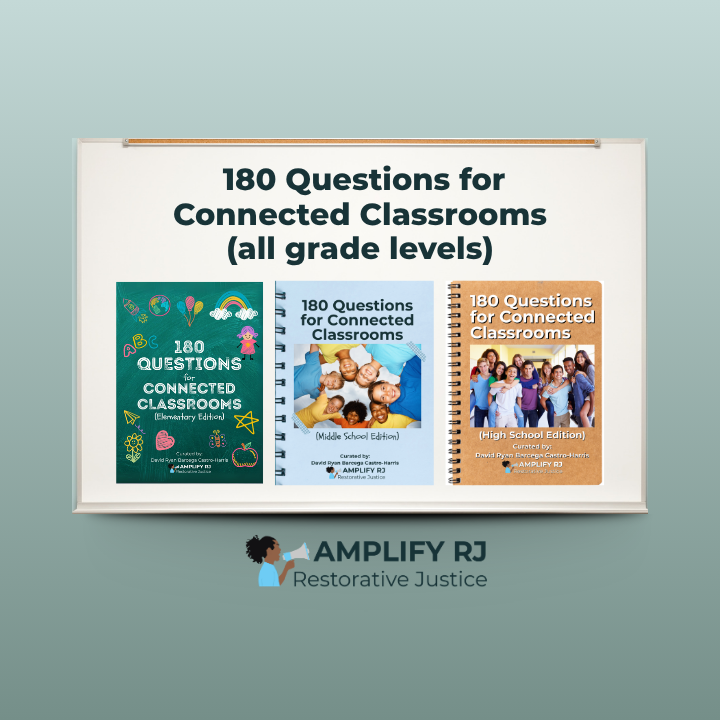
180 Classroom Connection Questions — $27
Relationship doesn't happen by accident. These questions give you a year's worth of entry points for daily check-ins, circle openers, and low-stakes community building that compounds over time.
Building Working Agreements for Adults — $27
Before students set agreements, the adults in the room have to do it first. This guide walks you through a process for co-creating the culture you're asking students to show up to.
Classroom Agreements with Students — $27
A structured process for building shared agreements with your students, starting from their values and experience, not a list of rules handed down from above.
Restorative Process Questions Guide — $27
When conflict happens — and it will — these questions help you respond in a way that addresses harm, centers relationships, and creates accountability that actually holds.
What this is and what it isn't
This is a starting point. These tools support a practice. They do not replace one.
- Restorative Justice is a philosophy and a way of being, rooted in Indigenous values of interconnection. It's proactive — you build relationships and community before anything breaks. And it's responsive — you repair when harm occurs. Both require practice, not just resources.
What's in this pack works when you engage it with real intention in real relationships with real students. It won't work on autopilot. It won't fix a school culture by itself. And it isn't asking you to be perfect — it's asking you to practice.
The efficacy of this work is in how you engage it.
This pack is for you if:
- You're an educator who wants to move from managing behavior to building community.
- You're a coach, dean, or site leader trying to give your team something concrete to work with.
- You're using part of your summer to set up your classroom before students arrive.
- You're someone who has been trained in RJ concepts and wants tools that reflect that framework.
- You're starting from scratch and want to begin with the right foundation.
This pack is not for you if:
- You're looking for a behavior management system that doesn't require relationship.
- You want something you can hand to students without doing the adult work first.
- You need a quick fix for a school culture problem that took years to build.
For your whole school or team
If you're a site leader or coach looking to bring this to a team, contact us about bulk orders or custom facilitation packages at info@amplifyrj.com.
Frequently Asked Questions
- Do I need any prior experience with Restorative Justice to use this?
No. The Starter Pack is designed to work whether you're coming in with no RJ background or looking to strengthen a practice you've already started. The course inside the pack builds the conceptual foundation you need before engaging the other tools. - Is this a curriculum I follow in order?
Not exactly. The course is the best place to start because it grounds everything else. After that, the tools are designed to be used in sequence with your school year — agreements at the beginning, connection questions throughout, the process guide when conflict arises. But you don't have to wait until everything is "set up" to begin. Start where you are. - How long does the self-paced course take?
The course is self-paced, so the timeline is yours. Most educators move through it over several days or across a few weeks alongside their regular work. The reflections are built in, so you don't need to carve out separate journaling time. - These tools are for my classroom. Can I also use them for staff culture?
Yes. The agreements process for adults was specifically designed for the adults in educational settings — teachers, paraprofessionals, coaches, administrators. Building relational culture with your colleagues is part of the same practice. - What if I'm a coach or dean supporting multiple classrooms?
The tools work at the individual classroom level and at the team level. If you're supporting several educators, reach out about bulk orders or facilitation support at info@amplifyrj.com. - Is this Restorative Practices or Restorative Justice? What's the difference?
The course addresses this directly. The short version: Restorative Practices often refers to a specific set of programs and protocols. Restorative Justice, in this framework, is a philosophy and a way of being rooted in Indigenous values of interconnection. The tools in this pack are grounded in that deeper framework, not a scripted program. - Will this work in a school that hasn't bought into RJ at the systemic level?
It can, with honest expectations. You can build real relational culture inside your classroom or your sphere of influence without waiting for your whole school to align. What you won't be able to do is run restorative processes in a vacuum — if a student gets suspended by administration right after a restorative conversation with you, that tension is real and this pack won't resolve it. The tools are valuable. The institutional limits are also real. - I've already been trained in RJ. Is there anything new here for me?
Possibly. The course is introductory, so if you've done substantial training it may cover familiar ground. The process questions guide and the agreements resources are practitioner tools that people with experience often find useful to have in a structured format. If you're unsure, reach out before purchasing and we can help you figure out if this is the right fit.