Check out our LIVE events!
What Is Restorative Justice?
I am David Ryan Barcega Castro Harris. All five names for all the ancestors.
If you found this page, you probably already have a sense that something is off about how we usually handle harm. A kid does something wrong and gets sent away from the people who could actually help them. A coworker hurts someone and HR opens a file. Something ruptures at home and everyone goes quiet and waits for it to fade. Most of us were taught that justice means finding the person who did the bad thing and making something bad happen to them in return. And most of us have lived long enough to notice that this rarely makes anything better.
Restorative justice starts somewhere else. This page walks through where the term comes from, how I define it, how it differs from the punishment-based approach most of us inherited, and the full architecture of the work. Take it in whatever order is useful to you.
Where the term comes from:
The practices behind restorative justice are older than any of the people who named them. Our ancestors handled harm this way for most of human existence. The English phrase itself shows up in print as far back as the 1830s. So this is not one person's invention, and I want to resist the tidy story that it is.
The modern term took shape across the second half of the twentieth century, through a handful of thinkers working separately. The psychologist Albert Eglash, writing about what he called "creative restitution" in the late 1950s, is the one usually credited with introducing the term, though even that is debated. The criminologist Nils Christie, in his 1977 essay "Conflicts as Property," argued that the justice system steals conflict from the people it actually belongs to. The legal scholar Randy Barnett developed the case for restitution over punishment. Their ideas converged on a few shared commitments: that the person who caused harm should make restitution to the person harmed, that everyone affected should take an active part, and that the punishment-and-retribution paradigm was in crisis.
Howard Zehr is the name most people know, and his role is specific: he popularized the term and gave the field its most influential framework in the 1990 book Changing Lenses. He said:
Restorative justice is a process that involves, as much as possible, everyone with a stake in a particular offense, so they can collectively identify and address the harms, needs, and obligations, and put things as right as possible.
Zehr came to this through years of trying to reform the criminal legal system, shaped by his Mennonite faith, and he was explicit that the deepest contributions came from Indigenous peoples, the First Nations of Canada and the U.S. and the Māori of New Zealand, whose traditions the field was, in many ways, validating after colonial powers had repressed them.
Zehr himself later offered a caution worth keeping. As the term spread, he noticed people using "restorative justice" to describe things that aren't restorative at all. I take that warning seriously. A lot of what gets sold under this name has been stripped of what makes it work. So when I give you my definition, I want to be clear about what I mean by it and how I hold it now.
How I define Restorative Justice:
Here is my definition. It is not the definition. It is the one I work from, rooted in a specific lineage and a specific set of values, and it has kept evolving as my practice has.
Restorative justice is a philosophy and set of practices, rooted in Indigenous values of interconnection, that emphasize repairing relationships when harm occurs while proactively building and strengthening relationships, rooted in equity and trust, to prevent future harm.
(I hold this as my interpretation, not a handed-down truth. When I first recorded the video below in 2020, my wording was a little different. I said "Indigenous teachings" and "maintaining relationships." I've since landed on "Indigenous values" and "building and strengthening," and added "rooted in equity and trust," because the equity piece isn't optional and I wanted the definition to say so. The wording keeps moving because this is a living practice, not a fixed doctrine.)
I broke all of this down in a video back in 2020. It's the foundation this page is built on, and the clearest way to hear it in full.
Punitive vs. Restorative:
One of the clearest ways to understand restorative justice is to look at what it stands in contrast to. Most of us were raised inside a punitive approach, which asks three questions when something goes wrong: What rule was broken? Who did it? And what do they deserve?
Those questions are what produce sky-high suspension rates in schools and mass incarceration in the legal system. They focus everything on punishing one person for breaking a rule, and they do almost nothing for the people actually affected.
A restorative approach asks a different set of questions: What happened? Who was affected, and how? And what needs to happen to make it as right as possible? That shift moves the center of gravity from the rule to the people, both the person who was harmed and the person who caused harm, and everyone the harm rippled out to.
The language shifts too. A punitive frame talks about crime and punishment, about victims and offenders or perpetrators. A restorative frame talks about harm and repair, about a person who was harmed and a person who caused harm. It's more of a mouthful, and it's worth it. Most of us have caused harm at some point, and most of us have been harmed at some point. It's unfair to reduce anyone to the worst thing they've ever done, or the worst thing that's ever been done to them. The restorative language keeps people whole.
Underneath both approaches is a different motivation. The punitive approach runs on fear and control: follow the rule or something bad happens to you. The restorative approach runs on relationship: I don't want to cause harm because I want to stay in good relationship with the people around me. One produces people who get sneakier about not getting caught. The other builds people who actually care about the effect they have on their community.
There's a deeper piece here about why a consequence isn't the same as a punishment, and why "they just need consequences" usually misunderstands what a consequence even is. That's a whole conversation of its own, and I'll link it here once it's written.
The Restorative Justice Tree
When most people talk about Restorative Justice, they're talking about the process: gathering the people affected by a harm to figure out how to make it right. That's real, and it's only one part of the whole. I use a tree to map the rest of it, because the process is like the branches of a tree. Branches don't grow on their own. They need a trunk, the trunk needs roots, and the roots need soil. Skip any of those and the branches don't hold.
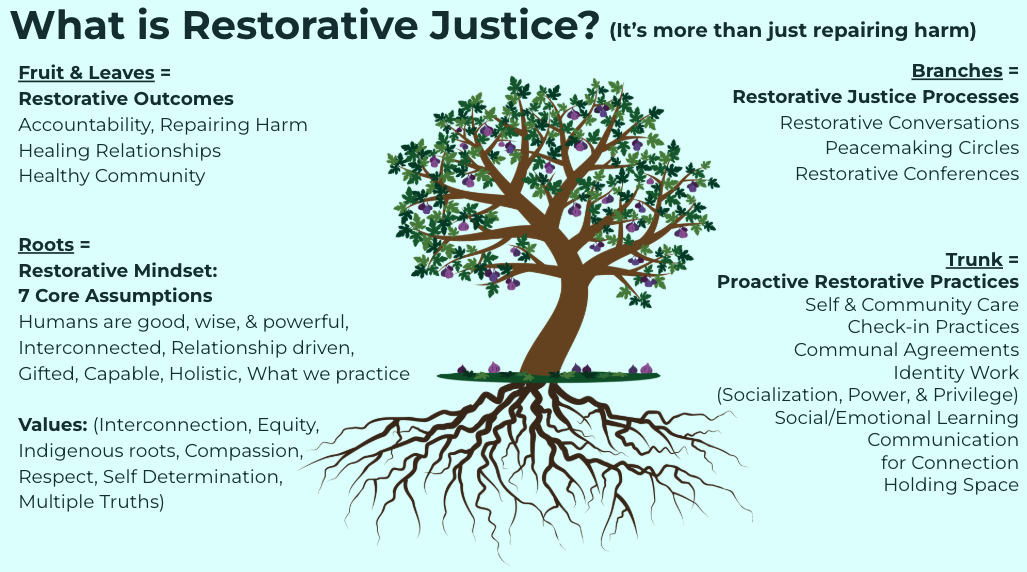
Roots: Restorative Mindset
The roots are a set of assumptions about people and how we're connected. I work from seven that Kay Pranis and Carolyn Boyes-Watson gathered from Indigenous teachings and other wisdom traditions, which you can find in their books Circle Forward and Heart of Hope. Among them: the world is profoundly interconnected; the true self in everyone is good, wise, and capable; every person wants to be in good relationship; everyone has gifts the rest of us need; everything we need to make positive change is already here; human beings are holistic; and we need practices to build the habit of living from that core self. That last one matters most. You don't change by deciding to. You change by practicing until the new way becomes who you are.
Roots: Restorative Values:
Just as my definition isn't the only definition, these aren't the only values of restorative justice. But a few of them I come back to constantly. Compassion and respect mostly speak for themselves. Equity needs to be named directly, because we live in a society that oppresses people along lines of gender, sexuality, class, ability, and, intersecting all of them, race. Restorative justice values everyone's voice equally, which in practice means refusing to privilege the voices that have always been privileged and refusing to discount the ones that have always been pushed aside. Racial equity is a core value of this work, and so is remembering Native peoples, who are still here and still too often left out of these conversations entirely.
Multiple truths says that everyone's experience is true to them, shaped by what they've lived and been taught, even when it isn't the whole picture. This isn't relativism and it doesn't excuse harm. It means you start by understanding how someone got where they are, because that's the only place change actually begins.
Interconnection and Indigenous roots sit at the center. When our ancestors lived in small communities, they had to find ways to deal with harm without throwing people away, because no one was disposable. That value shows up in language across cultures.
In Babayin, kapwa names a shared inner self with all beings. The Zulu word ubuntu says I am because you are. The Lakota mitákuye oyásʼiŋ means we are all relatives. The Mayan in lak'ech says you are my other me. These weren't accidents, and the disconnection from them wasn't either. It was done on purpose, through colonization and forced conversion. Recovering interconnection is part of the work.
And self-determination, because none of this works if it's imposed. People have to be able to make choices for themselves and move through these processes as participants, not subjects.
Trunk: proactive restorative practices
The trunk is everything you do before anything goes wrong. It starts with internal work, because the first relationship you have is with yourself, and you can't pour from empty. It includes building agreements together instead of handing down rules, so a community is clear on how it wants to be with each other. And it includes the ordinary practice of checking in, asking how someone actually is, not as a technique but as the thing that lets you catch a need before it becomes a crisis. A teacher who notices a kid came back different after the weekend, and asks, is doing the work that makes everything later possible. You build the capacity for accountability in the ordinary days, so it's there when you need it.
Branches: Restorative Justice processes
The branches are the responsive processes, the part people usually mean by "restorative justice." They ask the same questions: what happened, who was affected and how, and what's needed to make it right. That can happen as a conversation between two people, a mediated conversation, a conference that brings together the person harmed, the person who caused harm, and their supporters, or a peacemaking circle. Circles especially carry deep Indigenous roots, and I'm careful about how I teach them. I teach structure and facilitation and how to hold space. I don't package the ceremonial and spiritual dimensions into a workshop, because that asks for inner work no one-day training can deliver.
Fruit and leaves: Restorative outcomes
The fruit and leaves are what the whole tree produces: healing, relationships built or repaired, healthy community, and accountability. Accountability here means the harm is acknowledged, behavior changes, and where someone lacks the skill to change it, that skill gets built. A kid throwing pencils because multiplication frustrates them needs two things: a way to handle frustration that doesn't endanger classmates, and help with the multiplication. Punishment addresses neither. Repair addresses both.
What Restorative Justice is not:
It is not a softer punishment. It's often harder. Sitting across from someone you hurt, hearing what your actions did, and helping figure out how to make it right asks more of a person than taking a suspension and going home.
It is not a franchise you can install. There's a version of this work that's been scripted and standardized so it can be sold and rolled out at scale, stripped of the relationship that makes it work. I don't practice that version. Circle keeping is something you develop over time, in relationship, with your own willingness to be changed by it. It is not a box to check or certificate to earn.
And it is not, by itself, a fix for root causes. Restorative Justice surfaces what's actually going on in a community or an institution. It doesn't repair the conditions that produced the harm unless people are willing to look at those conditions and do something about them. I'll still do the work, and do it honestly, including being clear about where its limits are.
Why I do this:
I came to this work through watching people get shut out. Early on I was doing church-based employment work and kept seeing people with records turned away from jobs, locked out of the ordinary things that let a person rebuild a life. Later I was inside Cook County Jail and working with young people in Chicago, trained by people like Ora Schub and the Precious Blood Ministry of Reconciliation and Community Justice for Youth. I saw what our usual response to harm does to people long before I had language for an alternative. That's where I teach from. Not theory applied to the world, but a practice the theory helped me name.
"Learning about a previously misunderstood practice and understanding the origins and purpose of the practice, mindset, and approach to building school and classroom communities."
-Kathryn G.
"Harm is fluid — causing and receiving harm can be present in all involved, even if the surface doesn't suggest this."
-Hana C.
"RJ is about unlearning — and the explicit connections made between white supremacy culture, feelings, and needs when you are harmed or causing harm."
-Neha S.
Where to go from here:
Restorative Justice is about relationships, and you don't learn relationships by reading about them. The real thing is to practice, with real people, in real space. Here's how to go further, wherever you are right now.